Showing posts with label Basic. Show all posts

Saturday, September 17, 2011

Build Home Studio to Record Voice Over

Beraudiovisual’s friends, are you need to put a home studio to record the voice for home videos, indie/independent productions, film and more?

Do you have a computer with a sound card that can act as your DVR? Just add a little low-cost equipment and recording software on your PC, and can produce high quality recordings of voice easily and efficiently. What other equipment do you need?

Microphone.

To get your voice on your computer, you need a microphone. Do not use a bit of shit comes with your computer. High quality abundant cheap microphones and sound much better than that crap. For work in basic votes, I suggest that SM58 Shure SM57 is or. They are rugged, dynamic microphone that sounds good. The SM58 is ideal for female voice, as it reduces wheezing (Esses excessive) in some way. Men can choose from. The two microphones are available from music or audio equipment suppliers for less than Rp. 850.000. Also, get a microphone cable and a desktop computer a good position to hold the microphone while speaking.

Mic preamp.

Microphones put a small amount of electricity that the signal must be amplified. Sound card microphone preamplifier includes necessary. Unfortunately, like the cheapo mic that comes with the box, most of the mic preamps sound card is too noisy for serious work. If necessary you can use, but at least use a better microphone.
For the preamp, you can choose a small mixer to work with your microphone or a dedicated unit. Mixers essentially allows to connect several microphones and other devices (like a CD player) in one location and adjust their volumes independently. The Behringer mixer EURORACK MX602A between 6 microphone inputs, level control, and cost less than Rp. 500.000 Alternatively, two good choices for stand-alone mic preamps include DBX mini pre-tube preamp and the ART Tube MP Studio V3 preamp. Both are under Rp. 1.000.000 and available from the same sources mentioned above.

If you do not invest a lot of high-quality recording microphones, faulty, and your computer's audio interface. Two better choices are mic. For the purposes of pre-amplifier, select a device interface and preamp combination of audio, such as equipment Duo Edirol UA-5 or M-Audio.

Speakers and headphones.

While your computer speakers are adequate for recording, editing and finishing of basic laptops built to serve no purpose. Invest in some decent powered speakers, such as the Roland MA-8 micro monitors, and use them instead. Play back your recordings on a variety of stereo systems, car, etc. to control how they could be transferred to other environments. You can not listen to the speakers when you save, because they receive feedback when the microphone is on. Wear closed-ear noise that keeps leaking them to be picked up by the microphone.

Recording software.

Choose recording software with editing facilities to correct errors, the compilation of the best pieces, add music and / or sound effects, creating special effects, and deliver your finished voice tracks in the formats you need. A "light" version of a program of professional recording is Sonic Foundry, Sound Forge Studio.

Recording space in silence.

Its aim is to record a track clear, intimate voice, and that means keeping noise and the sound of the room outside the recording is finished. Professional recording in a sound booth specifically designed to keep noise and the sounds they make beautiful voice. These costs thousands of dollars and are a little more realistic for informal work. An article full, walk-in works as a taxi of his fortune, however.

Getting a good

The basic integrated sound card has three connectors: Mic-in, line and the line (or headphones) to the outside. Connect the device to connect the microphone to the mixer (or preamp), and connect the device to the output of the line sound card Connect the headphones, too. (If you have dedicted external interface that plugs into that. E 'connected to a computer via a USB port.)

Next, set the volume to a mixer (or preamp), using the controls and level meters. Start talking, watch his feet, and slowly turn up the volume until you get to almost 0 (zero), without going over.

Start the software that controls your sound card (it's usually the little speaker icon in the system tray). This is where you choose your recording source (LINE IN) and adjust its volume. Put this on 100% all the way up, and check your recording levels with your external mixer or preamp.

Start with audio recording software and get ready to save. Records mono, not stereo and CD quality (16 bit and 44kHz sample rate). You will notice that the audio software is not set the level of control, but do not rely on the meters when recording. Never, never more than 0 (zero) to a digital level meter. All this above the level of the distorted sound bad. He wants all the loud noise would fall below 0 for most digital well below the level (between -6 - 15 dB).

Mic technique

Greatly improve the sound recordings, closer to the microphone. The farther away from you, the more you earn the room around you. Your voice sounds thin and distant, like a movie at home. Closer, and your voice is intimate, the voice of the narrator prototype. Another advantage is closer to the microphone, you can increase the lower frequencies in your voice, and that can make the sound more powerful. How close? Put your lips 4-6 inches apart, about the width of your hand. Do not speak into the microphone. Instead, the position above the nose pointed down to his lips. Also, do not place the mic dead center of the lips. Move slightly to the right, for example, 20 degrees off axis. This leaves a clear understanding of the script, too.

Of course, finding their area of registration of any aircraft noise, such as computer fans. Put some distance between the microphone and the noise source. Also, avoid salty foods immediately before the recording session. It takes a little close to the warm water and apply some lip balm. They keep the mouth and lips lubricated. Eating a few slices of apple can help overcome the dryness of the mouth, too.

When you are ready to save, turning away from the microphone. Take a deep breath. Exhale. Take another deep breath. Open your mouth, back to the microphone and begin speaking. This technique eliminates the net consumption of smell and lip breathing, which often occurs when you start talking.

Speak slowly and clearly. You can always increase the recording during the editing stage. If you make a mistake, return to the closest phrase to start again and continue, even if you only one or two voice errors. Cut in a voice or phrase is difficult and does not seem natural.

Editing Records
There is no need to nail all in one take. Record the highest number of run-through, and the need to assemble the best of the last recording. Listen and evaluate what you did. Everything is there that you need? Sound good? It is the right level (not too low, does not distort)? Otherwise, go back and re-record the bits you need, listen, and repeat until you are satisfied.

Change the sound is like editing a voice processing program. You will not see the voices, but you can not see two-dimensional presentation of voices as sound waveforms. And you can hear the voices while playing. You can manipulate the waveforms as a move from voices on the Voice Processor. Cut, copy, paste all the techniques you're already familiar with the subject during audio editing.

Before you start editing, turn off the microphone, disconnect the headphones, speakers and go. It 'clear, to remove what is not necessary, as a clear his throat before he started talking, no talking between takes, strange voices, and so on. After removing the waste, to move towards improved performance. If you have several companies in the script, finding the best takes and build the last version of them.

Listen to the fundamental changes they make. I think that taking a long break, you can approach the records again with fresh ears. You can do better? The volume is constant? Do you hear noise, background noise or other unwanted parts could be eliminated or reduced?

After editing the voice, you can add sound effects or music to soften the last version. To add music with Sound Forge, open the music file on your audio software, select and copy to the clipboard. You may have to cut the music to match the duration of the voice recording in the first place. Next, place the cursor at the beginning of the voice recording and select Edit; Paste special blend. "Here you can control the level of the music (source) in connection with his voice (target). Ensure that the mixture again to ensure that you can listen to the recording of voice clearly with the background music.

As a last step, the use of software standardization process to maximize the volume of the audio recording. Select the entire signal and normalization of -0.10 dB (98.86%). Save this file in audio format you need, for example, MP3.

Now, you are ready to have a great voice over!
Read More >>

Friday, September 16, 2011

The Most Powerful Weapon of Filmmaker

The most important low-budget filmmaker is creative mind. It all starts with the original idea, there is a question of nourishment that thought until it grows to be a great idea. After that, it's something to this idea of making the film in every ounce of energy and resources, you may be able to bring up.

Movies are the most successful film festivals these days with films that were made in a fraction of the cost required to make a major Hollywood film studio. Technological advances have made that anyone can make a film. Film cameras, video cameras, sound recording equipment, and almost any other type of equipment you need to make a film can be bought at a very affordable price today. The computer that is available these days can provide a low-budget film with a very low production value that looks like James Cameron had something to do with the project. This professional look, along with a unique story can help any film likely to be accepted into film festivals such as Busan Film Festival, AVFEST (AVIKOM Festival), Toronto Film Festival, Sundance, etc.

Try as they might, the major Hollywood film studios never have a monopoly on creativity. They spend millions of dollars on search marketing in an effort to understand exactly what the audience of the film is the appearance of the world when they go to the films. Despite these efforts, we still have not found a formula. The tastes of the people going to the films are hard to predict how an earthquake is on the ground changes all the time. Because of this, the door remains open for creative professionals in the world to enter the game. All you need to do is come up with a unique idea that can turn into a film, enter your film in festivals such as Sundance, and then let the judges decide. While large studies have attempted to take over the festival circuit in recent years, provided the children with small, however, films are king creative in this realm.

It does not cost as much as you might think to make a film, that you can participate in competitions such as the Sundance Film Festival. Sony plans to release a line of high-definition camcorders that are perfect for those who want to make films with small budget. Even if the films are made of these cameras is described as a "film" (as the films were from the beginning), are (almost) seem to have been. These new cameras are able to provide high quality images, which is comparable to the image that the film offers. Two cameras are the PDW-F330 and PDW-F350, and offer all types of film properties, even the most faithful to the film a professional director to be respected. Both cameras offer true 24p recording in SD or HD, interval recording of shooting and recording a pair of lenses. F350 model also offers true variable frame rate recording which is also called "slow motion / fast motion" features.

Features like this are invaluable for anyone to make a low budget film, because it allows them to include motion effects in their films without the help of a cheap film camera or a film lab to high prices . Both cameras will be on the market in March 2006. The F350 costs about 25 000, while the F330 model will cost only about $ 16,000. PDW-F30 decks will be available in June through the 9000th These are small prices to pay to be a self sufficient independent filmmaker.

A filmmaker on a budget you can invest in an HD video camera and relatively cheap housing and have everything you need to make films as well as the mind and body can handle. All you need after a creative mind, a few thousand dollars, some friends of his actors and ambitious team, the screenwriting software such as Final Draft and a strong desire to make a film. They do not have to worry about the high cost of film, developing film, or film to DVD transfer. All you need is your camera and a $ 30 drive (23.3 GB) and will be filming an entire film. Buy a camera records is much cheaper than the films and buying all the baggage that comes with it financial.

When they shoot their film with one of these cameras, a filmmaker on a budget goes directly to their computer with the disk and start editing it using one of the many editing programs available that are affordable to our days such as Final Cut Pro. They can do all the work of post-production for their films on their computer at home as long as they are willing to take a load of the mother of their professional responsibilities.

Technology has made independent filmmakers to bypass many costly steps in the process of the film. Instead of paying a lot of people in millions of rupiahs an hour to film services are available only in cities like Jakarta and Bandung, they can now do all of these steps in the comfort of their own home on their own computer.

For anyone who has ever had a dream of making his own film, there's no better time than now to get there. The playing field was leveled in terms of technology, but also need a creative story to get anywhere on the festival circuit. Affordable equipment can be put down, but we must make a good game to win. A creative mind is your best player in this game, so if you have that part in charge of you are half way to make your vision a reality film. Feed your creative idea until it becomes a single script, then devote his life to making the script into a film. If your idea is as good as you think it is what you will do very well on the festival circuit. If this happens, could lead to a distribution agreement decent film. If you stick with it and keep making films that you can even find that you have made a career as a professional artist who makes independent films, and that dreams really can come true.

Read More >>

Monday, September 12, 2011

Know The Hands Signal of Floor Manager / Floor Director

Floor Manager
The Floor Manager / Floor Director remains in the TV Studio during production through headphones. Are in direct communication. Bidirectional control room Director. Normally, the talent can not use the headset and does not receive instructions directly from the Director. It is the responsibility of the Floor Manager / Floor Director acts as a liaison between the Director and talent.
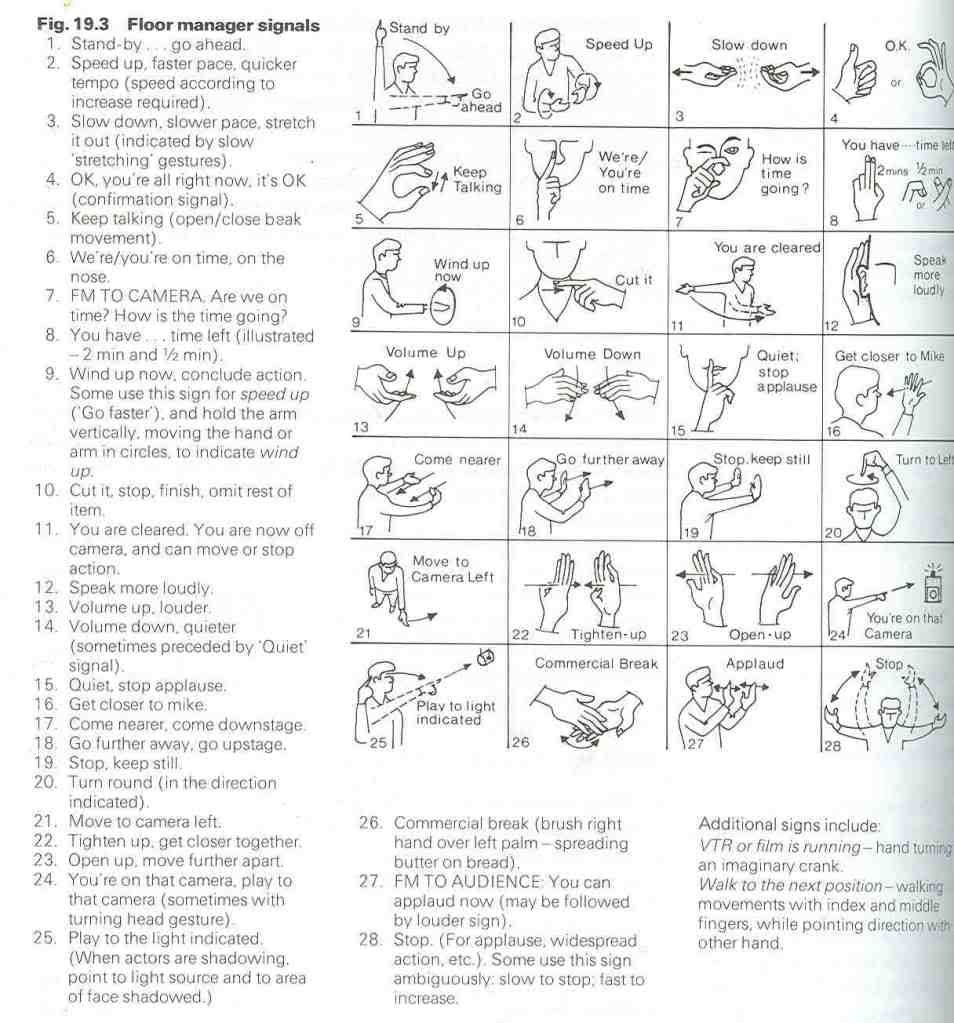
Since it is not practical to entrust talent orally during production, the Floor Manager / Floor Directorstands or kneels next to the camera that talent to speak and uses a system of hand signals to relay instructions of director . Although any system signal hand understandable from the floor manager and talent would work, it is recommended that you use the internationally accepted system shown in the picture.
The basic hand signals, both floor manager / Floor Director and talents must understand are listed in the following text.
1. Stand by
For a hand signal to  "stand by " floor Manager / Floor Director raises his hand and arm at the beginning of the Show or when additional subdivision.
2. Cue.
For the hand of "start talking" or "begin," the floor manager / Floor Director raises his hand and points to the talent.
3. Cut.
For the hand-signal to  "cease talking " or  "stop action, the floor manager / Floor Director pulls his hand " in his throat in a cutting motion.
4. Stretch.  
For a direct reference to  "stretch"  "it or slow down," Director floor pulling his hands together as if stretching a rubber band. The amounts are longer than the time when call manager puts his hands far apart at the end of the proposal extends; shorter time amounts when call manager puts his hands closer together.
5. Speed up.
The hand signal to "talk faster," the head of the section rotates his arm and hand clockwise in circles above his head. Speed refers to the urgency of the time.
6. OK.
For the hand signal, that "everything is in order, " the floor Manager / Floor Director is a circle with his thumb and index finger.
7. 30 seconds to go.
 The hand signal, which is 30 seconds remaining in the show segment, the floor manager / Floor Director forms the letter T in both hands.
8. 15 seconds to go
There are 15 seconds of the Show remained in the segment, and talent is doing text wraps to the hand/signal, resulting in a punch to floor Manager / Floor Director creates a movement by grabbing.
9. Speak more softly.
For hand signal to "speak more slowly" floor manager / Floor Director raises the Palm of the hand to his mouth.
10. Speak up
For a hand signal to  "speak,  ' floor Manager / Floor Director cups his hand to ear.
11. Speak or look at this camera
For the hand signal to "speak or look at this camera," floor management refers to the on-camera in his hand in the air. Waving pen motion from one camera to another, change the declarations of the talent leader is another must-air camera shot.
Floor Manager Hands Signals


Accurately and discreet when you send a signal tool. Don't spread your arms frantically in the air-this is a special MEW and mimic ability.

During the television production studio floor is usually a maze of lighting and camera cables, which may impede the movement of the camera and also be a security risk. The head of the Division must ensure that the cables are securely stored or located. In addition, he should find out from the camera operator and Director of the how much camera movement is expected.
If you cut to the talent and then cue them, you will see them waiting to begin or see action spring into life.  Cue them too early before cutting and action has begun already.  Wrong cueing leaving talent confused.  If they are finished with their piece, and you have not cut away to the next shot, they may stand there with egg on their face, so to speak, asking for ad lib or just grin!
Hand Cues or hand signals given by the Floor Manager / Floor Director by hand, are the standard method of tracking to start or stop.  Make sure that your signals can be seen by the talent and is included.  If necessary, Hand Cues basic to explain before the broadcast. Do not assume that they know what you are doing, particularly with inexperienced talent.
there are 28 signals that you have to recognize, for more pictures you can download it here.

Read More >>

Monday, August 1, 2011

Be A Cameraman

Hello beraudiovisual's friends. Did u know, being a cameraman is a challenge. For beraudiovisual's friends who want to become a cameraman, these are important things you should know.
 
Camera Language

Camera language is the language of international broadcast standards. So the language is commonly used in any television station.

ECU: Extreme close-ups (a detail shot)

VCU: Very close-up (shot face, from forehead to chin)

BCU: Big close-ups (whole head)

CU: Close-up (from head to chest)

MCU: Medium close-up (from head to
stomach)

MS: Medium shot (whole body before the foot)

Knee: Knee Shoot (from head to knees)

MLS: Medium long shot (whole body)

LS: Long shot (whole, ¾ to 1 / 3 screen height)

ELS: Extra long shot (XLS), a more extreme long shot

Zoom In: Object as if it came to kameraZoom Out: Object as if away from the camera

Pan Up: The camera moves (up) to the top

Pan Down: The camera moves down

Tilt Up: same as the pan up

Tilt Down: the same as the pan down

Pan Left: The camera shifts to the left

Pan Right: The camera shifts to the right

Track In: ​​The camera tracks (moved) closer to the object

Track Out: The camera tracks (moving) away from the object

Dolly In: the same track in

Dolly Out: same track out

For this type of shot that is often used is:

    
Long Shot or Full Shot, overall
    
Wide Shot or Cover Shot, the whole object in the scene
    
Tight Shot or Close Shot, visible detail
    
Shooting Groups of people, can be single shot, two shot, three shot etc. the whole picture.

Types of Cameras

Studio Cameras

The camera of this type in addition to having its own capabilities there are also some adjustment is controlled, the tool named camera control unit or better known as the CCU. As with other types of camera systems, studio cameras will be resting on alignment circuits but the digital techniques now have pre-set at all tuning circuitry, especially in a modern studio camera.
Due to the size of the studio cameras are very severe then the studio cameras are usually mounted on a dolly to be moved or shifted subtly.

Broadcast Camera Portable
The camera of this type is more slender, suitable for use in studios and in the field. With a zoom lens and the viewfinder is larger then the portable cameras are also used in the production studio. And because it is more slender than studio camera, the camera unit is able to work in the field directly. Portable camera has all the necessary circuitry and has an automatic functions. The camera of this type also has a videotape recorder as part of the camera body. Lightweight Lightweight Camera or Camera For the needs of manufacturers in the field also makes the type of camera light. Similar to the type of portable cameras, but these types of cameras even smaller. Can be used hand-held or tripod use. Small Camera This camera is more popularly known as camcorders. Kind of small, made as consideration for a cheap price. Used for home use, camcorders often found on the market. Electronic Sinematrography this camera type is the type of television camera designed with characters who resemble movie cameras. Using a tape which then transferred into celluloid form.

Parts of the Camera

Normal television cameras specially designed to suit specific applications. A studio camera for example, has a large viewfinder so the cameraman can easily correct the focus accurately. A news cameraman would be more comfortable with a compact camera as it is easy to carry even have to move where. Lens of the camera lens is the "eye" that berfugsi receive images naturally. The camera lens has peyesuai area, this type of lens called a zoom lens., But a fixed lens system most widely used. Beam Splitter (splitter light) In the system of color tv, color natural images sebenanya divided into three identical versions of the light is red, green and blue direflesikan of a subject. This can be done by three methods, namely

    
Dichroic mirror
    
Special block prism
    
or striped Filter

The camera tube, solid-state image sensors (CCD) Simply put, the top of the television cameras have 3 componen tube, divided into red, green, and blue in color images. Information in detail and brightness (luminance) emitted from the received composite color wave. CCD video camera now has a sophisticated, according to the types of cameras who were excluded. The location of the viewfinder Viewfinder lajimnya at least over the camera or on the left side of the camera. Viewfinder has yayar monochrome or black and white, but now there is also that already has a color screen. Mounting the camera mounting is the very bottom of the camera that function to rest the camera on a tripod, so the camera can be moved as desired from the cameraman.

Camera Control

All types of cameras have three sequence control: To re-adjustment during the retrieval gambarPenyesuaian diinginkanAtau condition when the change when the camera is "silenced alone". In most studio cameras tuned control on CCU separate from the camera. A Man CCU will control the color balance of light and dark and the other so the resulting images can be maximized. So a cameraman will concentrate on the framing alone. The question is, what if the cameraman using a portable camera or camera combo So the camera settings a cameraman must have the ability to set the camera settings. Camera Lenses camera lens camera is the eye or heart of the camera itself, a cameraman should be concerned right. System on the camera lens normally has three adjustment or adjustments that can be adjusted manually or semi-automatic. Focus, setting the distance where the image should be clear / fokus.f-stop, setting the variable iris diaphragm in lensaZoom, change the focal distance (focal length) adjusted how many views / images can be achieved. Overall that can be done on the control lens is that image or shot can be clear / focus, the image can have a depth or depth of field fine day, shot a good angle, and the "size" of the desired image. Angle lenses generally have a proportion of 4:3 television screen. The camera lens can normally capture images with the same proportion, 4:3. This becomes the reference count of how we can harness angle lens or angle lens. In addition to the normal lens, there are also narrow lens for shooting distant and widelens, to get an image more broadly. Control the zoom control serves to zoom closer to or away objects. This key code found on the W (wide angle) and T (Telephoto). If the zoom button is pressed on the W code then the picture or object appear closer (zoom in), if the zoom control dg T code pressed then the object will stay away (zoom out). Focus To make the image into focus, set or adjust the lens focus ring rotat. It can also be adjusted by changing the zoom control. Focus will also be much easier if the object that we have enough light shooting. f-numbers (f-stops) f-stop can actually be counted. It's just like the still photo lens (tustel). These figures are f/1.4 2 2.8 4 5.6 8 11 16 22 32. In fact these figures could be 3.5 4.5 3.6 typically used. For example in the first aperture of f / 8 to f / 4 means brighter images fourfold. In order to have a good depth of field should have adequate lighting. Exposure and Iris People often assume that a good picture is a bright picture. In fact this is not always true. The truth is that if an object has the correct tones. In a standard camera has an auto-iris, if this facility is enabled, then the lens will automatically set them, open the lens cavity. Auto-iris is useful when a cameraman have to move around the place where the lighting is not necessarily the same. Unfortunately, if this facility is used sometimes object to be not constant. So the good news is that this facility is used first, then use a manual iris. If moving the location or do it with different lighting auto iris back, estela it back to manual.

Types of Mounting

Monopods

Camera Tripod

    
Collapsible Tripod
    
Pneumatic Tripod
    
Rolling Tripod or Tripod Dolly

Camera Pedestal

Pedestal Field

Pedestal Studio

Camera Crane

    
Crane-arm
    
Motorized dolly
    
Large cranes

Special Mounting

Low shot (Low tripod, high hat, camera SLED)

High Shot (Camera Clamp, Hydraulic platforms, SkyCam)

Equipment should be prepared before shooting

In order not to miss any shooting equipment, usually made Pre-rehearseal checkout list. Among them:

    
Preliminaries (camera checked whether alive? Or need to warm up first)
    
Camera cable (make sure all the cables nicely)
    
Mounting / placemat camera
    
Viewfinder
    
Cable guards (serves to secure the camera)
    
Lens cap (lens cover), so the lens is dust and so on.
    
Focus (check whether the focus is good)
    
Zoom (checks whether the zoom can run normally)
    
Camera Batteries
    
Cassette
    
Lamp
    
Microphone
Read More >>

Wednesday, July 27, 2011

Jobs List Of Film Production (Part 4)

Soundman: A man was going to be responsible for managing the necessary votes in filmmaking. Including measuring the strength of the boom in capturing the sound recording when shooting.

Ass. Soundman: A person who assists the Soundman to carry out their duties. Although the U.S. is an Oran which will go directly to check and adjust the power of sound in the recording process of shooting.

Graphic Designer: Is a person who has the task to design for all requirements in the production of films related to the graph. Including cover design makes the film cassette when they wanted to be marketed. Because it is a graphic designer does not arbitrarily make the cover tape. But there must be a correlation between the film's story with the cover, but it also can make people see the cover so interested to see the movie. Then the graphic designer will work under the producer marketing department.

Music Illustration: In this job an MI will be tasked with finding and which will determine the music that will be used in filmmaking. But it should also look at the theme, story ideas, and the atmosphere that existed at the film, so that between story and music to rhythm and for the audience will feel able to enjoy it.

Boom Operator: A man was on duty carry, organize, and direct the boom on the objects that were photographed. This was done to clarify the sound occurs when recording, because it will happen probably low sound. That will make between images and sounds do not match.

Talent Coordinator: A person who has a very tough task to help the director to master talent or the existing cast. This is so that when the drop occurs on the psychic talent does not mengganngu mood, mental, and the desire to showcase the role desired by the director. This often happens when a film production halted due to a constraint, and the talent loses his mood to continue shooting / take.

Still Photography: A man was in charge of perpetuating the image that qualify as documentation. And usually a SP will work with the script department continuity and cover designer. Because no connection between that department.

Main Title Designer: A person who is responsible for creating and designing the main title is required in a film that is being tilled. Including the credits roll, opening title and closing title. Because a good title will also bring in a filmmaking success. But still there must be relevance between the two.

Behind The Scene Director: A man was in charge of making a film base stations. With the intent and purpose to be able to see and correct the deficiencies and what to look for the perfection of making a film. So in other kesmpatan can take the experience contained on behind the scenes are made.

General Workman: Workman Usually in general there are a lot of people. Because GW has a very diverse tasks, depending on what the department needed help from the General Workman. So GW could be called sie. Super busy in the production of a film.

Generator Operator: A person who is responsible for managing the generator if needed. Because if there is shooting off site that does not exist then the flow of electricity needed to turn the generator for lighting, video control, and all necessary tools in filmmaking that uses the services of electricity. Included in the event of a power failure, generator operators must be alert to mengidupkan genset to the film production is not inhibited.

Catering Coordinator: A man was in charge of preparing and managing the necessary food or consumption during production. For example when shooting schedule breaks and lunch time, the catering coordinator serving food should be ready for lunch. Likewise, the other breaks. Usually catering department coordinator works under the ass. Producer.

Driver: This is a duty to always be ready to take and carry tools and other items used in film production. Included in the event of transfer of production sites.

Crane Operator: A person who is in charge of preparing the crane if necessary.

Dolly Operator: A person who is in charge of running the dolly if necessary. And when the dolly is needed, then the director will soon be a member to Dolly Operator command to quickly create and prepare the rails and carry out the dolly under the direction of the director.

Jimmy Jip Operator: A person who operates the Jimmy Jip duty if needed.
Read More >>

Jobs List Of Film Production (Part 3)

Property: A man was in charge of looking for all the goods or anything relating to the artistic. Although usually preformance of filmmaking using properties that are difficult to find, then a property will initiate the desired goods or equipment, or bring in tools from a distance in film for smooth production.

Technical Director: It is a charge of checking all the equipment that smells preformance techniques of making a film. If problems occur on the tools used will be the responsibility of a TD, although working with Director Engineer, and Electricians, depending on what tools the problems faced.

Ass. Technical Director: A person who will help to check all the equipment associated with the technique in film production. And a super fast ATD must work to overcome technical problems that exist, so that the production process does not stop long. So it does not disrupt plans have been made by the producer.

Engineer Director: It is an expert in the field engineer (machinery). Who shall serve to check and repair the damage that use machine tools, after receiving the command from the technical director.

Ass. Engineer Director: A person who assists the ED to address the problem of existing machinery. And in practice, an AED is a direct jump to to repair all the damage that occurs engineer.

Casting Director: A person who is in charge of looking (to casting) talent or a cast that will portray the character in a movie. But a CD is also still consider the director of command and desire to recruit talent. So it will get a talent that can be portrayed in the film with good characters that are intended on the manuscript and desired by the director.

Ass. Casting Director: A person who will assist the task of a CD seeking talen / cast is desired, although an ACD will work directly in the field for selecting.

Electrician: It is an expert in the field of electricity that will be on duty to check all the means of production-related electricity, an electrician will also be assisted by technical director and director engineer, because mutual each other.

Ass. Electrician: A task that will help the electrician in the electric field when an issue occurs. And AE will plunge into the field immediately to cope with the guidance of chef electrician.

Clapper: A man was on duty at the time will show kliper shooting. And a Clapper has also served to replace the existing text in kliper. Like the turn of the scene, shoot, and take.

Script Continuity: It is a duty to observe and document a shooting. So there is no jumping at every follow-up scene in the movie. So if there is an ambiguous image in the shooting, then it is the fault of a SC which is less detailed story see the sequence of a scene being photographed. So to become an SC should have a thorough and tenacious nature.
Read More >>

Jobs List Of Film Production (Part 2)


Director Of Photography: It is a right hand of a director on the picture imaging. Because a DOP will determine what angle to be used on film shoots. And a DOP must understand the basics and the meaning of an angle in filmmaking. So between the story, atmosphere, and the shooting technique is not ambiguous. As this will be felt if the film was finished. The audience will feel less fit to see an image that is not harmonious with the atmosphere and story.

Ass. Director Of Photography: An ass. DOP has a duty to help a DOP. But helping the implementation of the field when the film production runs. Ass. DOP will direct and give the intention of the angle used to the director, cameramen, and artistic. So there will be harmony between the attitudes, images, meaning angle and background.
Story Boarder: A man was in charge of making images that have been designed according to the angle made by a DOP yag and intent of a director, but it will also provide insight to the artistic team for arranging and setting the place (venue) as contained in the image created by a story boarder.
Ass. Story Boarder: An Ass. SB is a waterfall that will give direction to the concerned (director, cameramen, artistic). While the SBE will act as the conceptor only.

Cameramen: A mainstay of the trust director to take a picture that has been in concept by the SW and Director. While the shooting should be according to shootlist have been made by a DOP. And his duties with the help of illustrations of a Story Boarder.

Ass. Cameramen: A man who helped take pictures of the other blade but still with a guide shootlist made a DOP. Because if the film-making requires more than one camera, then an Ass. Cameramen who was in charge of implementing it.

Editor: It is a mainstay of director on the film editing. Since in the editing process this will result mempenaruhi last couple of films, whether good or bad. Because of an editor should be able to give the impression of perfection in the film, if there are pictures or kuran low either. And the editor was a man who would become the deciding success or failure of the film when it was marketed.

Ass. Editor: His task help an editor make a sequence of frames in the desired and expected by a director. So preformance practice an editor is the drafter, and an Ass. The editor is the executor.

Sound Editor: It is an expert in the field of sound to be inserted in each frame on the film done.

Ass. Sound Editor: A man who served as the executor of the will to use audio editing film preformance. Including if sprinkle sound effects if the original sound is not feasible to include in the frame. So the task of Ass. SE is looking for, create, annotate other effects similar to effects / sound of the original.

Special Effects Editor: A person who is in charge of making the desired special effects such as a director but still sticking to the script there yan. Although a SEE is the conceptor.

Ass. Special Effects Editor: A man was helping the SEE to find, create, and provide the desired special effects such as a director. These special effects have more value in a film, because it will give a strong character in the film that can not be generated through the camera shots.

Chef Lighting: A master of lighting in film production. Although usually a chef is only as a drafter and lighting director lightingman it.

Lightingman: It is a chef who will help arrange the lighting to the required light in every scene in the making of a film. And lightingman work according to the direction of Chef Lighting as the conceptor.

Art Director: trust is an expert in the field of artistic director. Art Director will lead a department that is in the shade. (Makeup, stylish, set builder, wardrobe, properties).

Make Up: It is an expert makeup contained on the art department in charge make up the cast is desired by scenario / script and director.

Stylish: It is a grammar expert stylish / hair that will be tasked with realizing the scenario and the director wants. Gives the same impression with the manuscript.

Set Builder: It is an expert in arranging space and property used in the filming. But the story board should look at existing, as well as shootlist that has been made so as not to be confused with the manuscript.

Wardrobe: A man was in charge of determining the costumes and clothing worn by a cast in a movie scene. But considering the manuscript, and the story.
Read More >>

Monday, July 25, 2011

Jobs List Of Film Production (Part I)

Beraudiovisual's friends, when we're watching a movie, then we must know who the people are behind the film. The following is a list of jobs in film production.
 
Cast: A cast character in a story to be filmed. A cast will perform his duties as a figure who has been determined by a text story. With a plot that has been written by the playwright. In addition, a cast must portray the character and expression with the direction of a Director.

Story Idea: An idea that makes the story will be filmed. Usually a story idea also had a role in making the manuscript
. Script Writer: It is a playwright who has got the acc from a story idea to create your manuscript story. Because a script writer should be able to get a taste (feel) the manuscript made the story.

Ass. Script Writer: A helper script writer. Usually an Ass. SW will be typing and writing it. So the SW can also be called a conceptor, was the realization is ass. SW.

Executive Producer: A exc. Producer is a leader and regulator of all activities in filmmaking. Producer also managing finances, making shooting schedule, and other problems in the domestic production of a film. In addition, producers must prepare a plan. For example plan A, plan B, plan C, even up to tens plan. This is so that if the main plan failed, then the stock plan will be used, because in order for a production is not chaotic rundown of his schedule as planned. So a producer must be sensitive to the problems and constraints in a film production, and soon took the decision to act, so that production remains smooth.

Ass. Producer: Is a person who assists the work of a producer. AP is usually called the unit manager. So the task is a unit manager of financial and management problems. While a producer is only as the head in the production of a film.

Marketing Producer: A producer marketing division. That is, those in charge of marketing a film to the public so that the film can be enjoyed by the audience. A producer maketing very influential on behavior or failure of a film market.

Director: It is one with the second highest position after the producer. A director is the leader of all the crew in the production of a film. In addition to the creator of a movie scene, directors also must master the technical and non technical in filmmaking. So almost all aspects of film production must be controlled by a director, including in matters of film editing. Seoran director also has the task to accompany a preformance editor to edit the film, so the story remains film preformance largely what a film director as a drafter.

Ass. Director: A man was helping the duty of a director. But usually an ass. Director is the person who deal directly with the cast / characters. Including directing styles, expressions, gestures and other body, after receiving the command from an executive director.

Read More >>

Basic of Shot I (shot composition)

The Basics "Shot"

Hello beraudiovisual's friends. When we watch a film or show on television, we are actually watching a series of shots within a scene, and a series of scenes in a sequence, and so on until we see it as a whole shows or movies.

What Is Shot?

The simple definition is like this:
When we press record button until we press the same button again, then it is a one shot.
Although only a second or even up to one hour from beginning to end, whether moving or not.

A good shot is a shot that is able to deliver the message.

The series of shots is able to provide stories that can be understood by the audience. unfortunately not all messages can be conveyed with good and trouble is this is because of "mistakes" of the creator of the message.
why?
because the shot should not only technical matters, mechanical, and aesthetic. Delivering the message will also deals with philosophy and philosophy of the shot.

Shot Size

shot size is the size of the subject in a frame.
type of shot is composed of:

ECU: Extreme close-ups (detail shot)

VCU: Very close-up (facial shots) from the top of head to chin.

BCU: Big close up (CU tight, full head) face fills the screen

CU: Close-up. From head to shoulders

MCU: Medium close-up

Knee, 3 / 4 shot: knee

MLS: Medium long shot

ELS: Extra Long Shot (extreme LS, XLS)

each size of shot has a different meaning when it is implemented in a shooting.
Long shot
In general, the use of this shot will be done if:
- To follow a wide area or when a scene "walk faster".
-to indicate where the scene was (indicate where).
-to show progress.
-to show how the position of the subject has a relationship with others.

Medum shot
This type of shot as the most commonly encountered in film and television. This type of shot is the most secure, because there is no special emphasis as well as long shots and close shots. all the scenes can be displayed with a neutral in this shot.

Close shot
Television is a medium close-up. Initially the premise is there as it pertains to technical terms.
- First. event with television media should be shown in close up because of the size of a small television when compared to the movie screen.
- Second. different from the movies, television shows watched by just a glance, and would be more suitable for displaying images with a close shot (solid)

need to understand precisely the meanings that ditampilkjan when the shots were made in close-up.
close-up effect is usually, would seem more dominate, suppress. no aesthetic sense, there is also a psychological meaning.

Read More >>

Author Profile

My photo
I am a film editor who currently lectures at one private university in Yogyakarta. incorporated in AVIKOM (Audio-Visual Communication)